

Cultural Deal for Europe: 4 takeaways from the Annual Policy Conversation 2026
MCA participated this week in the Cultural Deal for Europe – Annual Policy Conversation. In this article, a brief account from MCA’s perspective of what emerged during the conversation between European policymakers and civil society.
The lights dim, the BOZAR stage turns green. The Annual Policy Conversation of the CDEU, now in its 6th edition, co-organized by Europa Nostra, European Cultural Foundation, and Culture Action Europe in Brussels, is beginning. The day’s objective is to create a dialogue between representatives of the cultural sector and EU policymakers (particularly parliamentarians and Commission staff) regarding the hottest topics for culture and creativity.

The BOZAR room hosting the Policy Conversation © CDEU partners
This year, the focus of discussions has obviously been on the European Union’s long-term budget (Multiannual Financial Framework), the European strategy for culture (the Culture Compass), and the active advocacy role that the sector should assume. Participants from all the cultural sectors came and a strong French presence was insured by the CAE’s French Hub members, of which MCA is a coordinator. With a powerful and straight-to-the-point opening speech, Isabelle Schwarz from the European Cultural Foundation listed the 2026 objectives of the Cultural Deal for Europe initiative:
- Position culture and the sector centrally in the future MFF
- Strengthen culture’s role across other sectors and policy areas
- Permanently position culture and its role as guarantor of democracy and social justice in the language of high-level EU strategic speeches (such as the annual State of the European Union Speech)
- Double overall funding for the sector
Members of the European Parliament (MEPs), heads of the organizations leading the event, and the Commissioner for Culture Glenn Micallef then took to the stage. For MCA, 4 main reflections emerged:
Protecting democracy means protecting (and funding) culture
Most speakers agreed on one point: faced with a geopolitical situation where the EU finds itself in a “war of ideas,” the democracy that distinguishes the European model and values is threatened. In Isabelle Schwarz’s words, “Europe cannot defend democracy if it does not defend culture […], the cultural and creative sector’s work resists the simplification and interference from above” typical of authoritarian regimes.
MEP Nela Riehl (Germany, the Greens and Chair of the CULT committee) also emphasized that “if we don’t fund and protect culture now, we won’t have freedom of artistic expression
in the future,” a litmus test of a system’s level of democracy. MEP Hannes Heide (Austria, S&D), speaking about efforts made to protect Creative Europe, insisted that economic and employment discourse must be accompanied by concepts of democracy and freedom: the former without the latter causes a society to fail. Protecting the sector means financing it to allow it to continue to exist. EU funding is crucial for maintaining the independence of cultural initiatives, particularly in countries where national governments may be hostile to free expression or where the cultural sector is neglected, as noted by MEP Zoltán Tarr (Hungary, EPP).
In MCA’s statement for the next MFF, we emphasize how a European budget must start from the values we want to defend and convey. The first among these is the defense of democracy and democratic participation, and we argue that “a democratic space is always a fertile area for innovation & economy.” The statement is available at this link.
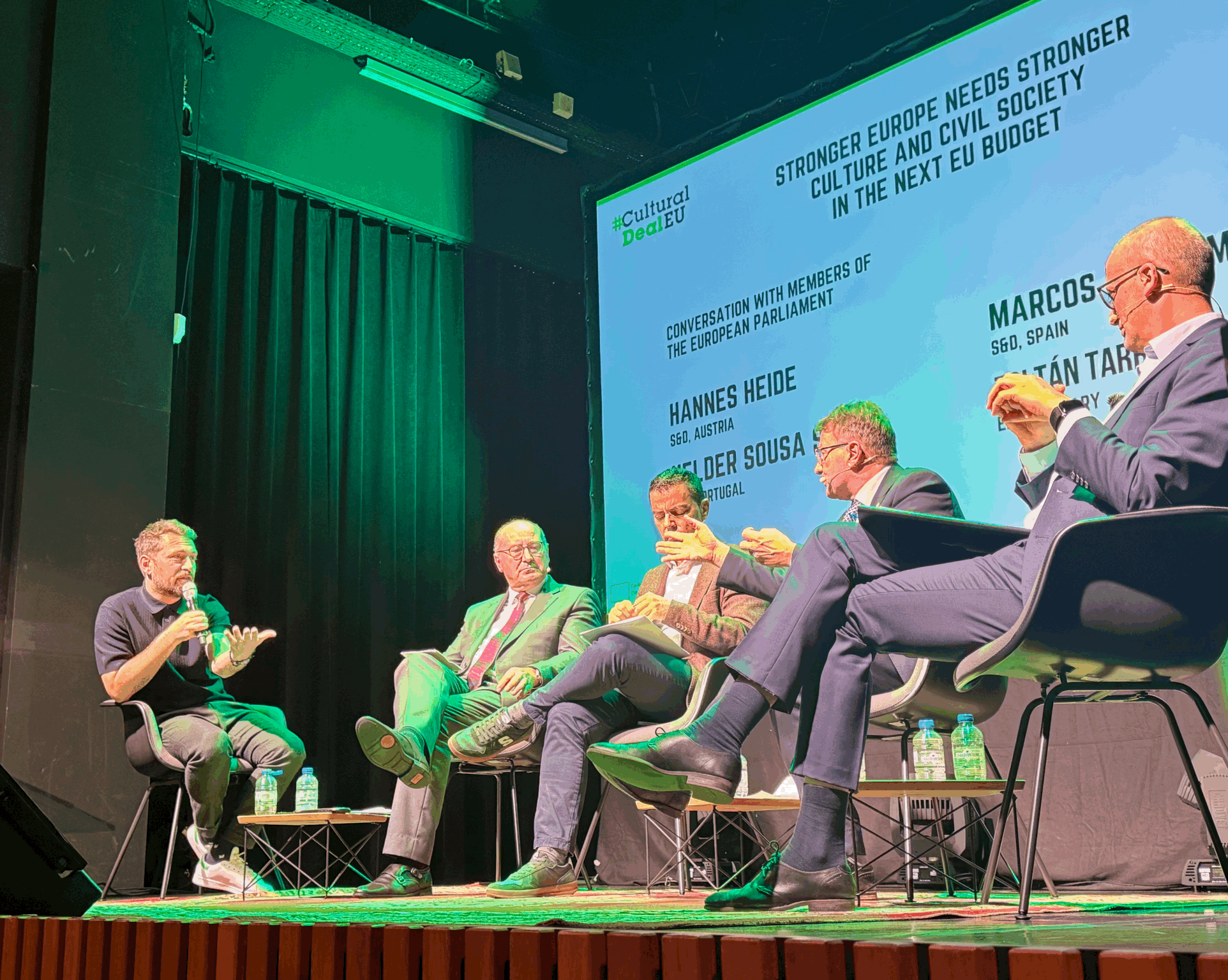
The 4 MEPs discussing with the moderator © CDEU partners
AI in the focus of Commission and Parliament
Both Parliament and Commission are going full speed regarding regulating, boosting, reflecting on the impact of Artificial Intelligence systems. MEP Nela Riehl announced the CULT committee’s intention to initiate an Own-Initiative Report (INI) on AI’s impact on the cultural sector, to complement the already adopted report by MEP Axel Voss (Germany, EPP) on “Generative AI and Copyright – Training, Creation, Regulation”
An Own-Initiative Report (INI) is a report drawn up on issues that fall within the competence of a European Parliament Committee, and which it prepares at its own-initiative: the Committee has not been requested to give an opinion nor consulted on the matter.
Commissioner Micallef emphasized how the “AI strategy for the culture and creative sector” is one of two priorities (along with working conditions for artists) on which the cabinet is focusing: space will be given to how to ethically develop and implement Artificial Intelligence systems in the sector, solutions to the problem of using copyrighted works, but also how cultural professionals can seize the opportunities that technology offers.
MCA has been active on this subject since 2022, work we have continued with Culture Action Europe through the Action Group on Digital & AI. We will therefore closely follow all these important discussions. At the same time, MCA urges not to work in silos regarding AI and digital; many of the problems these strategies aim to address are not specific to machine learning-based systems, but rather exacerbations of elements already existing in the digital field. Ethical development of digital solutions, participatory governance in digital institutional policies, data exploitation and independence from the overseas tech giants… : it is important to maintain a broad, long-sighted discourse that can see beyond, after this bubble has burst.
The Culture Compass, a strategy to seize
In November 2025, the Commission’s new strategy for the sector was published; we analyzed the details regarding the digital and research sector in this article. A few months later, the Commission has fully entered the implementation phase of the Flagship Initiatives that characterize the strategy’s concrete actions. Commissioner Micallef insisted on the collective ownership aspect of this document, developed through consultation with the sector. He said: “This is not my compass, this is our compass.”
We published an overview of the Culture Compass in this article.
What emerges from the conversation with various MEPs is that the Culture Compass is now recognized as a strategic tool, especially for its statement value. The European Union recognizes culture as a strategic dimension with this compass, so it’s up to stakeholders to appropriate this document to strengthen their advocacy for the sector, especially regarding the next MFF. The concretization of this will be, as set up in the Compass, a Joint Declaration “Europe for Culture – Culture for Europe”, where the European Parliament, the Council of the EU and the Commission will reaffirm key principles for cultural policy in Europe.

Commissioner Micallef talking about the two main focuses for the next months
The wish to burst the sectoral bubble
The CDEU policy conversation is an important moment for civil society to come together and discuss the future of European cultural policies. However, everyone agrees with everyone, because we are all on the same side of the fence. The MFF challenge requires different tools and a different approach. As MEP Helder Sousa Silva (Portugal, EPP) outlined, the sector’s position must be ensured in every pillar of this budget:
- the presence of specific funds for culture in the European Competitiveness Fund (ensuring a pillar for culture and creativity in Horizon Europe that is currently absent),
- recognizing the importance of culture in National-Regional Partnership Plans (local governments are fundamental for capillary investment in the sector),
- and investment in international cultural diplomacy through the Global Europe pillar.
Moments like the 2026 Policy Conversation should be starting points, to then strengthen policymakers and civil society in the work of convincing those who are not already on board for culture. MEPs outside the CULT committee, other Directorate-Generals beyond DG Education, Arts and Culture, the various Council committees dealing with preparing MFF proposals: these are all actors whom the sectors’ advocates should reach, because they are not already part of the conversation. MEP Marcos Ros Sempere (Spain, S&D) illustrated this concept, showing a way forward. In the MFF, he says, we have vertical silos regarding budget lines: the goal must be to create a horizontal pipeline for culture through amendments to the Regulations (legislative acts) that define the various pillars, in order to create transversal and constant support for the sector. MEP Nela Riehl, addressing the audience, invited them to “reach out to our colleagues in the Parliament […], the CULT committee is here to listen and we are standing strong at your side, but we need to convince other people.”
The 2026 Policy Conversation was a gathering moment for the sector, extremely important for taking stock of the situation and moving forward together. Big congratulations to the organizing team for managing this large operation and for enabling the participation of so many people.
Find more details about the event and the whole initiative at https://culturaldeal.eu/
MCA continues to follow policies and funding schemes for the cultural sector in policy areas like digital and research. We are ready to create synergies for advocacy purposes for our sector: together we are stronger! For collaboration proposals, contact us at contact@michael-culture.eu
*Parts of this article have been translated from Italian with Sonnet 4.5 (Claude).


